
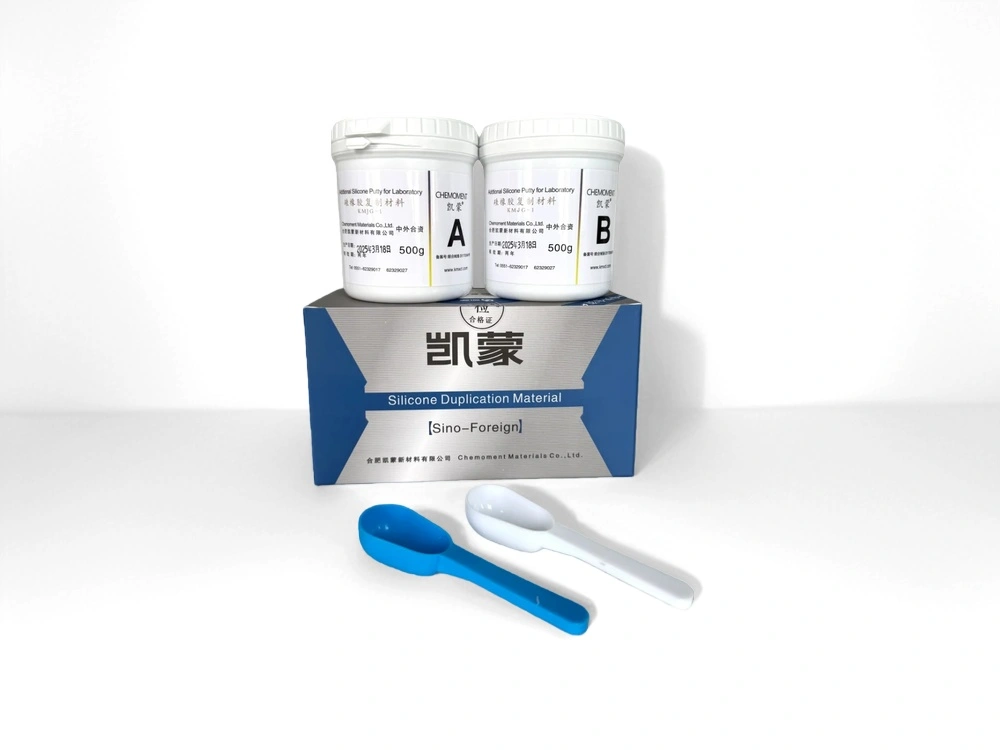
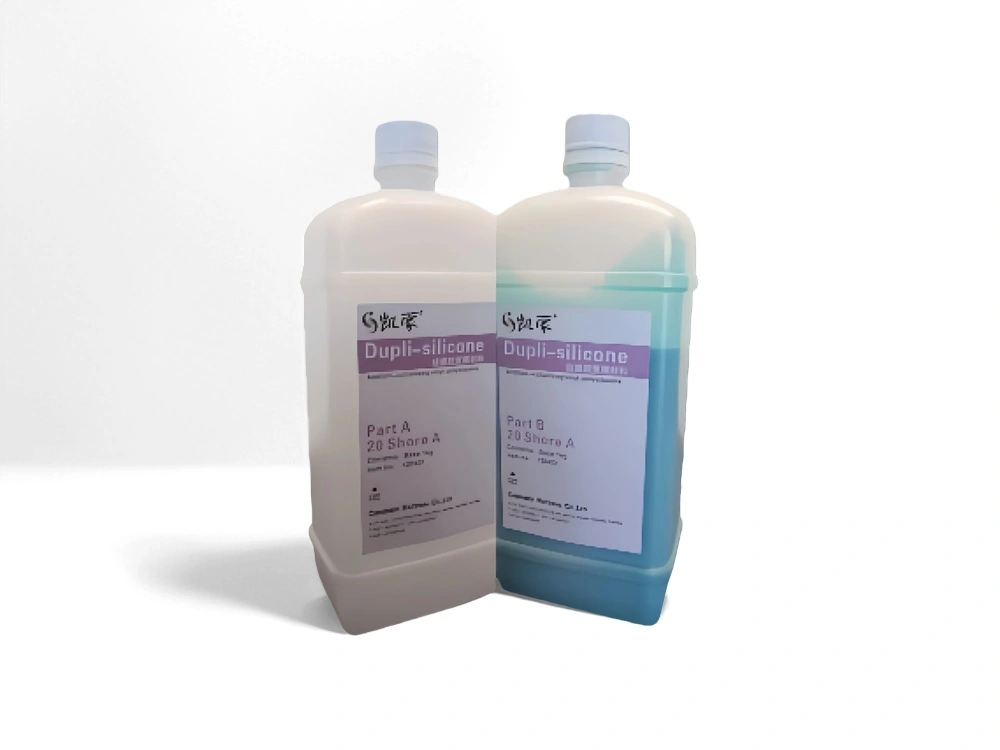
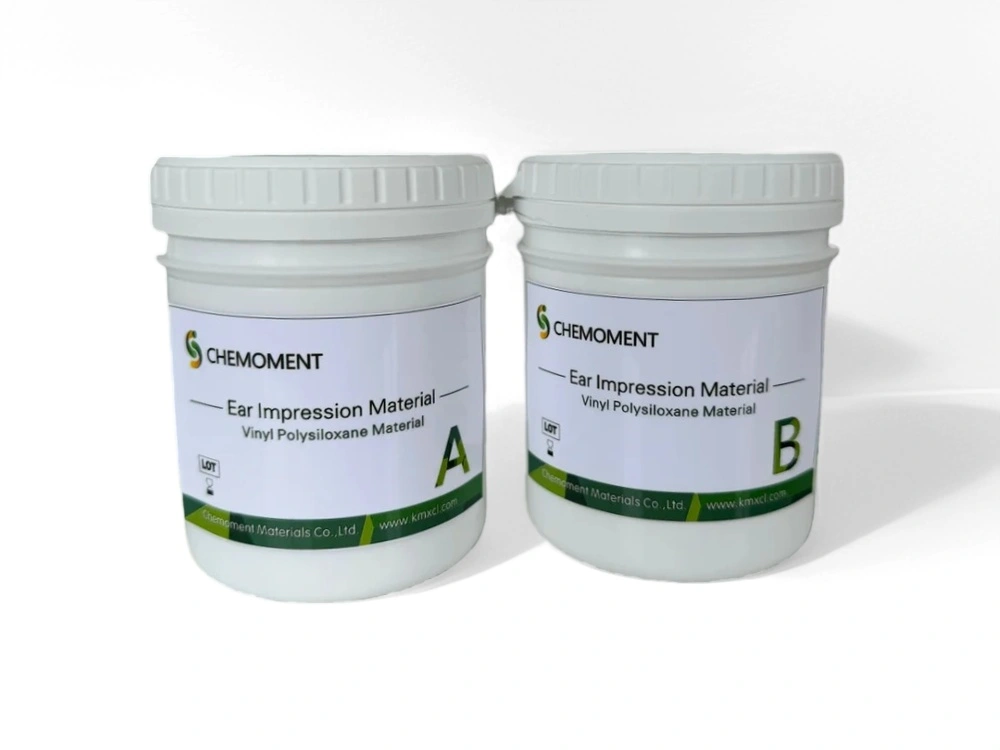
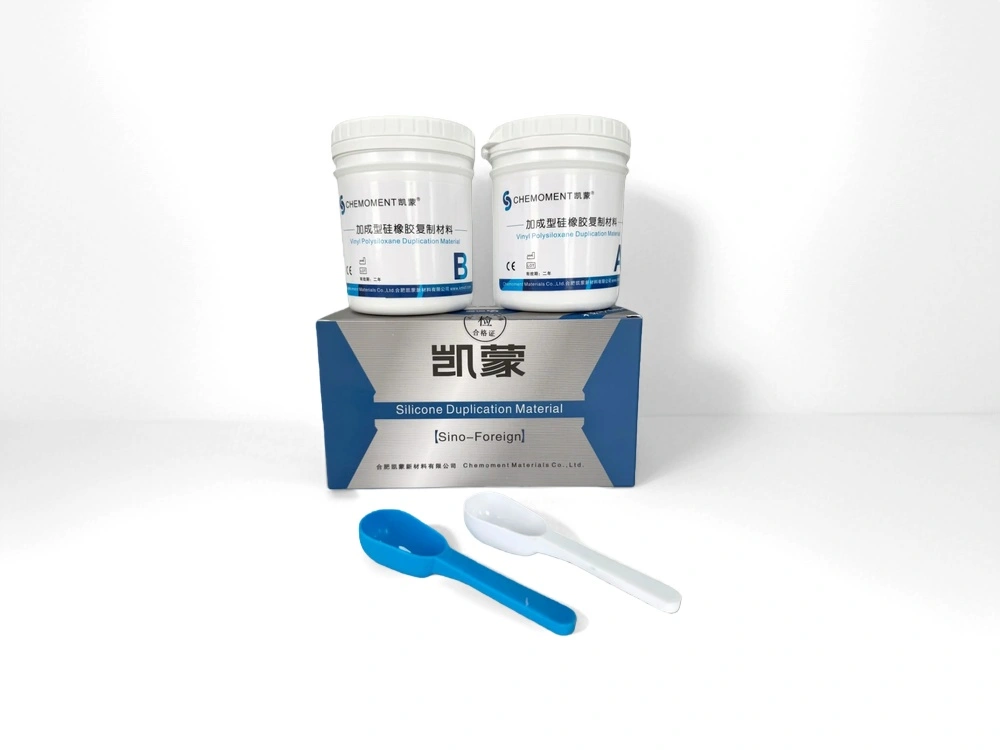


Addition silicone and condensation silicone are both elastomeric dental impression materials, but they cure differently. That difference has a direct effect on dimensional stability after the impression sets.
Addition silicone—commonly called VPS, PVS or A-silicone—uses an addition-curing system. Its main crosslinking reaction does not produce the volatile alcohol by-product associated with conventional condensation silicone.
Condensation silicone, or C-silicone, uses a condensation reaction. A volatile by-product is formed during curing, and its subsequent loss can contribute to continued dimensional change.
For that reason, addition silicone is generally preferred for definitive crowns, bridges, implant restorations and workflows where an impression may not be poured immediately.
Condensation silicone can still work well when the technique is controlled and the impression is processed within the manufacturer's recommended time.
So the practical difference is not simply that one material is “modern” and the other is “old.”
Addition silicone gives the clinical and laboratory workflow more tolerance after the impression has been taken. Condensation silicone is usually more dependent on prompt processing.
Addition Silicone vs Condensation Silicone: Quick Comparison
| Factor | Addition Silicone | Condensation Silicone |
|---|---|---|
| Common names | VPS, PVS, A-silicone | C-silicone |
| Material type | Elastomeric silicone | Elastomeric silicone |
| Curing reaction | Addition curing | Condensation curing |
| Volatile condensation by-product | Not characteristic of the main curing mechanism | Yes |
| Dimensional stability | Generally higher | More time-sensitive |
| Delayed pouring | Better suited | Usually less forgiving |
| Fine-detail reproduction | Well suited to precision restorative work | Can be good with correct technique |
| Elastic recovery | Generally high | Good, formulation-dependent |
| Common delivery | Automix cartridge, putty or multi-viscosity system | Commonly base + catalyst systems |
| Typical positioning | Precision restorative impressions | Conventional and cost-sensitive workflows |
| Typical material cost | Higher | Often lower |
Both material families fall within elastomeric dental impression materials. The current international standard for elastomeric impression and bite registration materials is ISO 4823:2025.
Why Does the Curing Reaction Affect Dimensional Stability?
The difference becomes easier to understand once you stop looking only at the impression immediately after removal.
The impression still has work to do.
It may need to be:
- Disinfected
- Stored
- Packed
- Transported to a dental laboratory
- Poured later
- Used for additional laboratory procedures
The dimensions recorded in the mouth need to remain dependable during that period.
What Happens with Condensation Silicone?
Conventional condensation silicone cures through a crosslinking reaction that produces a small volatile by-product.
After setting, loss of that volatile component can contribute to continued shrinkage. Research on condensation silicones has measured dimensional changes after setting and has also shown that the amount of change varies between formulations.
For a clinic using C-silicone, pouring time deserves real attention.
An impression that will be poured shortly after removal presents a different risk from one that may remain on a bench, travel to another facility and only then reach the model-production stage.
There is no useful universal rule such as:
“All condensation silicone must be poured within exactly 30 minutes.”
The validated window should come from the specific material manufacturer.
For buyers, a C-silicone technical sheet should therefore state more than working and setting time. The recommended maximum delay before pouring and the storage conditions used to support that claim are commercially relevant specifications.
Why Is Addition Silicone Usually More Stable?
Addition-cured silicone follows a different crosslinking route and does not rely on the same volatile condensation by-product mechanism.
The set impression therefore generally undergoes less dimensional change from this source.
This is one reason addition silicone became widely established for high-precision restorative impressions.
The advantage becomes particularly useful when the laboratory is not beside the dental chair.
If the impression needs to survive disinfection, packing and transportation before pouring, a wider dimensional-stability window makes the workflow easier to control.
Is Addition Silicone More Accurate Than Condensation Silicone?
For high-precision restorative work, addition silicone is generally the safer material choice.
That does not mean a freshly taken condensation silicone impression is automatically inaccurate.
Accuracy is influenced by the complete procedure:
Material + tray + wash space + mixing + seating + removal + storage + pouring
Studies comparing silicone impression techniques have shown that well-controlled addition and condensation silicone systems can both produce clinically useful casts.
The difference becomes more relevant as time passes.
A condensation silicone impression that is handled and poured promptly may perform very well. If the same impression waits substantially longer than intended, dimensional change becomes a larger concern.
Addition silicone generally gives the operator a wider margin.
For material evaluation, that suggests a better test than simply looking at a freshly removed tray:
Compare the impression at the point when the laboratory is realistically going to pour it.
For a chairside laboratory, that might be a short interval.
For an export dental laboratory, centralized lab or distributor market, the realistic interval may be much longer.
That is the test condition that matters.
When Should You Choose Addition Silicone?
Addition silicone is particularly useful when dimensional error has a high clinical or laboratory cost.
Crown and Bridge Impressions
A definitive crown or bridge impression needs to capture prepared teeth and relevant margins while maintaining their relationships after removal.
Low-viscosity material is commonly syringed around the preparation while a higher-viscosity material provides support in the tray.
Chemoment's Light Body VPS Impression Material is designed for precision workflows including crowns, bridges, veneers, inlays, onlays and implant-related impressions.
The wash should not simply be “as thin as possible.”
In sample evaluation, a useful light body needs a balance of:
- Flow around the preparation
- Thixotropic control
- Sufficient working time
- Predictable intraoral setting
- Integrity in thin sections
- Recovery after removal
A material that flows impressively on a mixing pad may become difficult to control intraorally.
A material that feels firm quickly may look efficient until the clinician needs additional time for a multi-unit case.
Handling should be judged in the intended procedure, not in isolation.
Multi-Viscosity Impression Systems
One advantage of modern VPS/PVS systems is the ability to build a coordinated set of viscosities.
A restorative range may include:
- Light body
- Medium body
- Heavy body
- Putty
- Bite registration
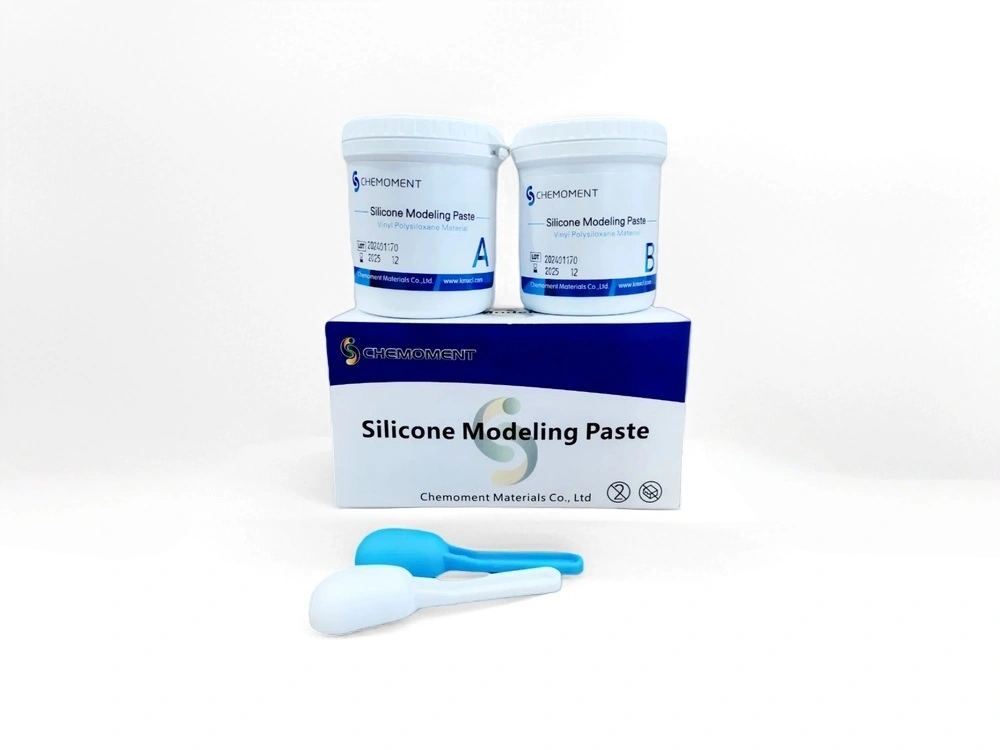
Chemoment's VPS dental impression material range follows this type of structure.
Heavy body and light body, for example, perform different jobs in the same impression.
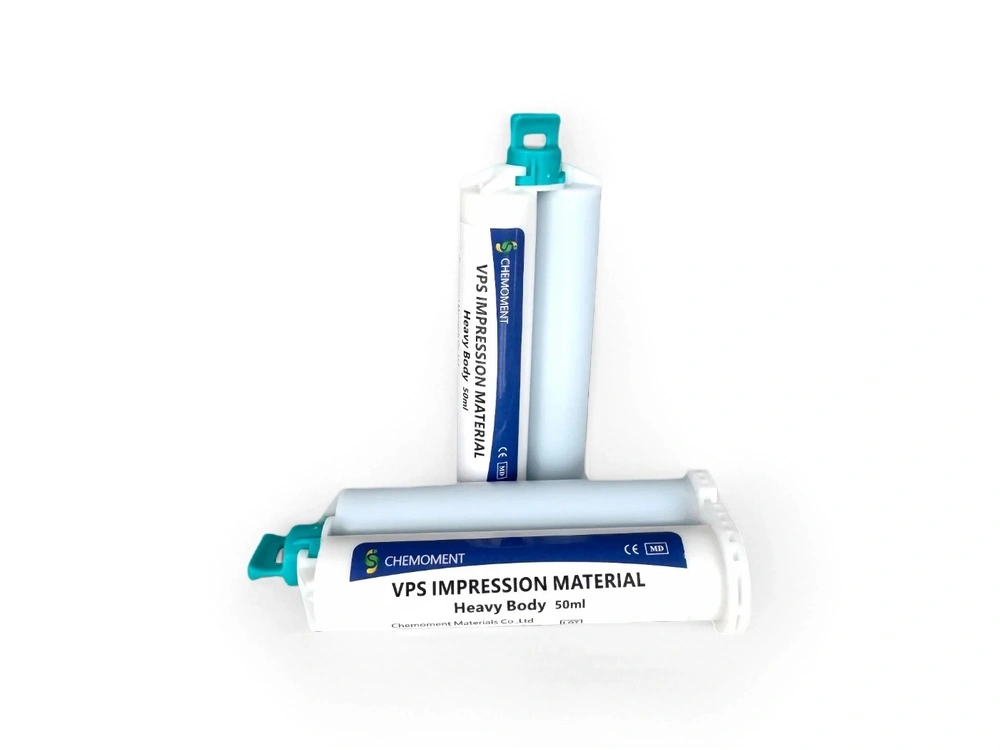
The Heavy Body VPS Impression Material provides tray support, while a light-body wash is used where greater flow and detail reproduction are required.
For distributors, compatibility between the viscosities matters almost as much as the specification of each individual SKU.
A good light body paired with an unsuitable heavy body does not create a good impression system.
Implant Restorative Work
Implant impressions can depend on accurate transfer of spatial relationships between restorative components.
The set material needs to deform during removal and recover afterward while preserving clinically useful geometry.
This is one of the situations where the elastic and dimensional behavior of addition silicone becomes especially valuable.
Technique remains critical. Material chemistry cannot compensate for inadequate tray rigidity, uncontrolled wash space or incorrect removal timing.

When Can Condensation Silicone Still Be a Sensible Choice?
C-silicone still has a place in some markets.
It may make sense when:
- The clinic already uses a reliable condensation-silicone technique
- Impressions are poured promptly
- Prolonged storage is uncommon
- The application does not demand the same time tolerance
- The market is strongly price-sensitive
- Customers prefer conventional base-and-catalyst systems
A dental team that has used the same hand-mixed system for years may also value familiar catalyst proportioning, visual mixing cues and handling characteristics.
Changing to automix VPS affects the workflow as well as the chemistry.
For those customers, the useful question is not whether C-silicone is “obsolete.”
The important question is whether its dimensional window fits the real laboratory workflow.
If the impression is normally poured shortly after the appointment, the difference between two material systems may be less commercially significant than it would be in a workflow where impressions travel for many hours before processing.
What About Putty-Wash Impressions?
Both addition- and condensation-cured silicones can be used in putty-and-wash approaches.
The putty provides bulk and support. A lower-viscosity material captures finer detail.
Chemoment's Hydrophilic VPS Putty Impression Material is an addition-cured PVS putty intended for putty-wash workflows.
The chemistry is only one part of the result.
Wash space, tray selection and whether a one-step or two-step technique is used can all influence final dimensions.
This becomes important during supplier comparisons.
If Product A is tested with controlled wash space while Product B is tested with inconsistent material thickness, the comparison is not very useful.
Supplier samples should be tested with the same tray, material thickness, mixing procedure, storage interval and pouring method.
Otherwise, technique variation can easily be mistaken for material performance.
Are Addition and Condensation Silicone Hydrophilic?
Neither silicone category should be assumed to behave like an inherently water-based hydrocolloid simply because it is used intraorally.
Traditional silicone chemistry is relatively hydrophobic.
Modern formulations—particularly VPS products—may incorporate surfactants to improve wettability. This is why the market commonly uses terms such as hydrophilic VPS.
“Addition silicone” and “hydrophilic” do not mean the same thing.
One describes the curing system. The other describes a performance characteristic influenced by formulation.
The same caution applies to condensation silicone. Its wetting behavior should be evaluated from the actual formulation rather than inferred from the C-silicone category name alone.
Chemoment's broader comparison of Hydrophilic VPS vs Alginate vs Condensation Silicone looks more closely at the role of moisture behavior across these material families.
Good isolation still matters regardless of the hydrophilic claim on the package.
Addition Silicone vs Condensation Silicone for B2B Buyers
A technical data sheet is useful, but it is not supplier qualification.
Two silicone samples can both look excellent five minutes after setting.
The differences that matter to a distributor may appear later.
Test at the Real Pouring Delay
This is one of the most useful checks when comparing addition and condensation silicone.
If customers normally pour impressions after two hours, test them at two hours.
If impressions in the target market commonly travel to a laboratory and are poured the next day, the evaluation should reflect that workflow.
Testing every sample immediately after setting creates an artificially favorable comparison for materials whose main weakness is time-dependent dimensional change.
For private-label sourcing, the evaluation interval should match the actual customer journey.
Evaluate the Delivery System Too
For cartridge-based addition silicone, check:
- Cartridge fit
- Plunger movement
- Base/catalyst extrusion balance
- Mixing-tip connection
- Uniform mixed color
- Material remaining in the cartridge
- Repeated performance from cartridge to cartridge
These details can create more customer complaints than a small difference in a laboratory specification.
For condensation silicone, focus more closely on:
- Catalyst dosing
- Base/catalyst mixing uniformity
- Visual indication of complete mixing
- Working-time repeatability
- Storage stability of the components
- Dimensional performance at the intended pouring interval
Repeat the Test Across Batches
One good development sample proves that a formulation can perform.
It does not prove that commercial production will perform the same way repeatedly.
For bulk or private-label purchasing, compare multiple production batches for:
- Viscosity
- Working time
- Setting behavior
- Color
- Extrusion or mixing
- Elasticity
- Packaging fit
- Dimensional results
Batch consistency is often less visible in supplier quotations than price or set time, but it has a much greater effect on long-term distributor complaints.
Which Material Is More Cost-Effective?
Condensation silicone is commonly positioned at a lower material price.
That can be attractive in price-sensitive markets, particularly when impressions are poured promptly and the clinical technique is already established.
Addition silicone usually sits at a higher price level.
For definitive restorative work, however, the relevant cost is not only the material used in one tray.
A failed or repeated impression can also involve:
- Additional chair time
- Another patient visit
- Delayed laboratory production
- Staff time
- Remake risk
For a routine case with a short processing interval, the lower material cost of C-silicone may be meaningful.
For a high-value crown, bridge or implant case, the wider stability margin of VPS may justify a higher material cost.
Material economics should follow the consequence of error.
Quick Answer: Which One Should You Choose?
Addition silicone is usually the better choice when:
- Definitive restorative accuracy matters
- The impression may be poured later
- Laboratory transportation is involved
- High dimensional stability is important
- An automix workflow is preferred
- Multiple viscosities need to work together
- The product is positioned for premium restorative dentistry
Condensation silicone can remain practical when:
- The impression is poured promptly
- A proven C-silicone technique is already in place
- Long storage is not required
- Conventional hand-mixing is preferred
- The target market is highly cost-sensitive
The actual manufacturer's instructions and validated technical data should still take priority over general material-category rules.
Frequently Asked Questions
What is the main difference between addition and condensation silicone?
The main difference is the curing reaction. Conventional condensation silicone forms a volatile by-product during crosslinking, and subsequent loss of that component can contribute to dimensional change. Addition silicone does not use the same volatile condensation by-product mechanism and is generally more dimensionally stable after setting.
Is addition silicone the same as VPS or PVS?
Yes. In dentistry, addition silicone is commonly called VPS, PVS or A-silicone. VPS means vinyl polysiloxane and PVS means polyvinyl siloxane.
Why is addition silicone more dimensionally stable?
Its curing reaction does not involve the same volatile by-product mechanism associated with conventional condensation silicone. This reduces one important source of post-set dimensional change.
Can condensation silicone be used for crown and bridge impressions?
Yes. Correctly selected and handled condensation silicone can produce useful crown and bridge impressions. Addition silicone is generally preferred when higher dimensional stability or delayed laboratory processing is required.
How soon should condensation silicone be poured?
There is no universal pouring time for every product. Follow the validated instructions for the specific C-silicone. Unnecessary delay should be avoided because dimensional change after setting is more relevant for condensation-cure systems.
Is condensation silicone hydrophilic?
It should not be assumed to be hydrophilic simply because it is a silicone impression material. Wettability depends on the formulation and any surface-active components used by the manufacturer.
Can an addition silicone impression be poured more than once?
Many VPS/PVS systems are chosen for workflows requiring good dimensional stability, but the number and timing of permissible pours should follow the instructions for the specific product.
Which silicone should a dental distributor choose?
For precision restorative and premium clinical markets, addition silicone is generally easier to position. Condensation silicone can remain relevant in price-sensitive markets with prompt laboratory processing and established conventional workflows. Distributor qualification should include actual pouring-delay testing and batch-to-batch consistency, not only a fresh sample.
Final Takeaway
The difference between addition silicone and condensation silicone becomes most important after the impression has set.
Both can record dental anatomy.
The bigger question is how well that record survives the time between removal and laboratory processing.
For crowns, bridges, implants and workflows where impressions may be transported or poured later, addition silicone usually offers the more forgiving dimensional-stability profile.
Condensation silicone can remain an effective and economical material when the clinical technique is established and the impression moves quickly into model production.
For B2B buyers, comparing the materials immediately after set is not enough.
Test the impression at the delay your customers actually experience, then repeat the same evaluation across production batches.
That tells you much more about a supplier than the words “A-silicone” or “C-silicone” on the label.
References
- ISO 4823:2025 – Dentistry — Elastomeric impression and bite registration materials
- PubMed – Dimensional change of condensation silicone impression materials
- PubMed – Dimensional stability of elastomeric dental impression materials
- PubMed – Accuracy of addition and condensation silicone impression techniques
- PubMed – Effect of storage time on dimensional accuracy of impression materials