

Quick answer: High-hardness VPS/PVS is one of the most common materials for routine occlusal bite registration because it allows the patient to close with relatively little resistance, sets quickly and becomes rigid enough to support articulation. For a repeatable product specification, confirm working time, time in the mouth, final hardness, dimensional stability and cartridge or mixing-tip compatibility.
The important purchasing point is not simply that a material is “hard.” A useful bite record must first capture the correct relationship with minimal distortion, then remain stable while the models are mounted. Low closure resistance, clean removal and adequate final rigidity must work together.
Why VPS is commonly used for bite registration
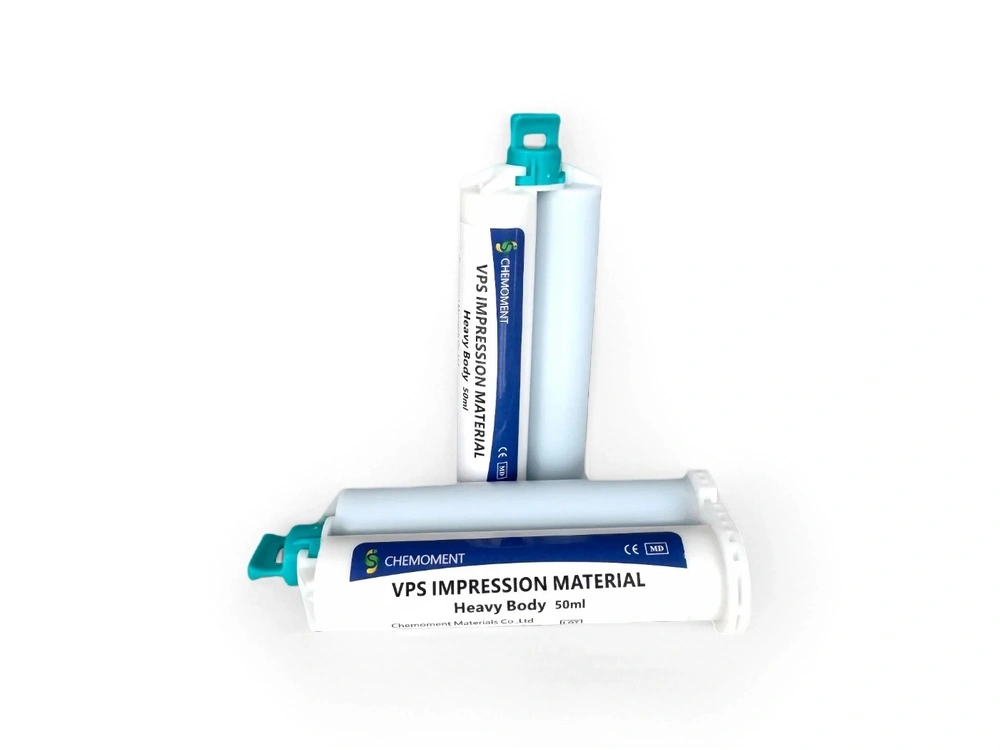
An addition-cured VPS bite material is normally supplied as a two-component cartridge system. The mixed paste enters the occlusal space, the patient closes into the intended position, and the material sets quickly enough for a routine appointment. After removal, the record should retain its shape without being easily compressed.
This combination suits crown, bridge, implant and other restorative workflows in which the laboratory needs a stable interocclusal record. It is distinct from impression putty, which is designed for tray support and impression making rather than recording the bite.
What “durable” should mean for a bite record
Buyers often describe the requirement as durability. In practice, several properties matter:
- Compression resistance: the cured record should resist deformation when handled and mounted.
- Dimensional stability: the occlusal relationship should remain stable between removal and articulation.
- Elastic recovery: the material should recover predictably after removal from undercuts.
- Trimming behaviour: excess material should cut cleanly without crumbling or smearing.
- Working window: the mixed material must remain usable long enough to place and close, but set promptly afterward.
A softer record can compress under handling. A material that is hard but difficult to place, brittle or dimensionally unstable may also fail. High final hardness is useful only when the rest of the handling profile is controlled.
Current Chemoment bite-registration specification
| Parameter | Published data | Buyer implication |
|---|---|---|
| Working time | About 30 seconds at 23 °C | Requires an efficient injection and closure sequence |
| Time in mouth | About 35 seconds | Short appointment time, with patient cooperation still required |
| Curing time | About 65 seconds | Confirm safe removal and handling against the written test method |
| Final hardness | About 90 ± 2 | Provides firm support for handling and articulation |
| Package | 50 ml + 50 ml cartridge with mixing tips | Check dispenser, tip and continuous-flow compatibility |
| Custom options | Working time, setting time, hardness and packaging can be discussed | Define limits and perform a full material re-qualification |
Review the dental bite-registration material specification and request the current technical datasheet for the selected pack format. Product values should be confirmed for the specific production specification, not copied from a generic material category.
How to use a VPS bite record correctly
- Confirm the patient can close into the intended position before loading the material.
- Dry the occlusal surfaces enough for the material to remain in place.
- Use clean instruments and avoid sulfur-containing gloves or contaminated equipment.
- Inject a controlled amount around the occlusal contacts rather than an oversized mass.
- Guide the patient into the correct closure and hold the position during the specified time.
- Remove according to the product instructions and inspect for voids, drag marks, penetration or incomplete records.
- Store and transport the record without pressure or heat exposure.
An inaccurate closure cannot be corrected by a harder material. Likewise, trimming away excess material must not remove the occlusal stops needed for mounting. This is where bite registration differs from a simple impression.
When another material may be considered
Wax remains inexpensive and easy to adapt, but it can deform with temperature and handling. Polyether can offer high dimensional stability, while bis-acryl and resin systems can provide high rigidity. These alternatives may suit specific clinical or laboratory systems, but they introduce different handling, removal, cost and material-compatibility requirements.
For routine repeat orders, the decision should be based on the actual procedure and validation data. The main Chemoment option is the high-hardness VPS bite-registration product described on the dental bite registration material page.
What distributors should check before ordering
- the intended clinical use and the required final hardness;
- working time at the actual clinic temperature, not only at room temperature;
- time in the mouth and the safe removal point;
- cartridge, plugger, mixing-tip and dispenser compatibility;
- batch consistency for hardness, cure time and color;
- packaging, shelf life and shipping conditions;
- technical data, safety data and market-specific regulatory documentation;
- a defined process for changes to material, packaging or production.
Use the working-time and hardness qualification checklist when a custom setting is requested. The buyer should not approve a custom bite record from one sample or from a single hardness number.
Reduce bite-registration errors
Common errors include using too much material, allowing movement during cure, leaving a void in a key occlusal stop, removing the record too early or letting the patient close outside the intended position. A record that is hard but captures the wrong relationship is still a failed record.
For a related clinical comparison, review the article on putty versus bite-registration material. This helps clinics and distributors keep impression and registration products in the correct workflow category.
Frequently asked questions
Is a harder bite-registration material always more accurate?
No. Accuracy depends first on placing the patient in the correct relationship. Final hardness supports the record after capture, but it does not correct a closure error or poor seating.
Can impression putty be used as bite registration?
It is not the intended use. Putty is selected for tray support and impression making. A dedicated bite material has a different working window and final hardness.
What causes a VPS bite record to remain soft?
Check cartridge seating, the mixing tip, ratio, temperature, storage, expiry and possible contamination. Sulfur-containing gloves and other catalyst inhibitors can also delay or prevent cure.
How should buyers qualify a custom bite-registration formula?
Test at least three production batches with the intended cartridge and temperature. Record working time, time in the mouth, removal time, final hardness, dimensional stability, trimming and seating performance against written acceptance limits.
Bottom line: Use hard, dimensionally stable VPS bite registration because it supports the complete mounting workflow, not because hardness sounds superior. Confirm the timing profile, cartridge system, batch consistency and clinical procedure before approving a product for repeat supply.